

The mountains were not visible that day.
Lubna and I reached Dochula in the morning hours of October. From Thimphu, it is barely an hour’s drive — but the road is not easy. A winding mountain path, bend after bend, dense forests of pine and deodar on either side. As the car climbed higher, the air grew lighter, the sky a deeper blue. And then, without warning, the road opened into a vast, sweeping plateau — Dochula Pass.
At roughly 3,100 metres above sea level, this pass is one of Bhutan’s most important mountain crossings. Anyone travelling from the Thimphu valley towards Punakha must pass this way. On a clear day, an unbroken chain of Himalayan peaks stretches across the horizon from here — from Gangkhar Puensum to Jé Gangphel, one snow-covered summit after another. Some Bhutanese guides say that on a crisp winter morning, more than thirty Himalayan peaks can be seen simultaneously from this single vantage point.

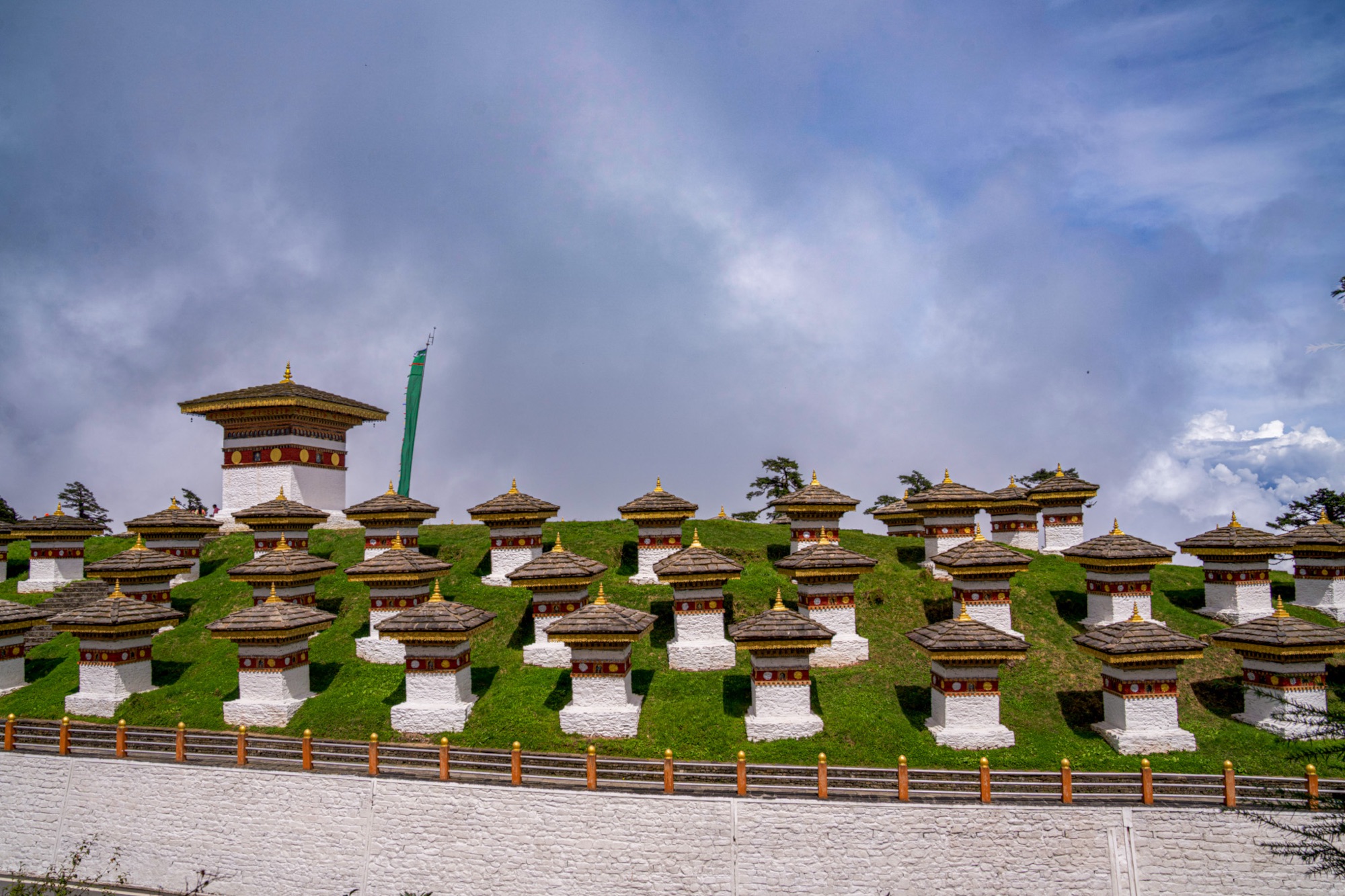
But on the day we arrived, the mountains stayed hidden. Cloud had descended low, mist was drifting in all directions. The Himalayas were behind their veil.

Yet Dochula gave us no less for it.
The moment we stepped onto the plateau, the chortens appeared — 108 of them, known in Bhutanese as the Druk Wangyal Chortens. Arranged in concentric rows across a green hillside, white-bodied with golden crowns, each carrying delicate rooftops and fine ornamental detail. Standing among them in the mist, they feel as though they have risen from some other, quieter world.

They were built in 2004. During the reign of Bhutan’s fourth king, a military operation was conducted along the country’s southern border — against armed insurgent groups that had entered from Assam. The operation was successful, casualties were few. In gratitude and remembrance, the Queen Mother Ashi Dorji Wangmo Wangchuck commissioned the construction of these 108 chortens. In Buddhist tradition, the number 108 is sacred — it represents the 108 earthly desires of the human mind, and liberation from them is the path to enlightenment.
But standing before them, that history does not occupy the mind. What remains is a quieter feeling — that someone, once, sat here for a long while and thought deeply. Then arranged these stones in silence, and left.
At the centre of the complex stands a small temple — the Dochula Temple, or Druk Wangyal Lhakhang. Inside: a Buddha statue, the scent of incense, colourful murals covering the walls. Around the temple, a garden — Bhutanese flowers, small trees, clean stone paths. Visitors come, walk around, take photographs. Yet the place never feels busy or loud. A quiet peace holds it, always.
We sat in that garden for a while. No urgency, no conversation. A cold wind moved through the deodar trees. Strings of prayer flags — red, white, blue, green, yellow — swayed gently in the breeze. In Buddhist belief, these flags carry prayers into the wind, dispersing the words of peace in every direction. From somewhere in the distance, a temple bell rang, faint and unhurried.
There is a particular weight to this kind of silence — one that does not reach the ears, but settles somewhere in the chest.
Dochula is known as a place to see the Himalayas. On a clear day, you are rewarded with that long, boundless view of the peaks. But on a day of mist and cloud, it gives no less. There is a different kind of mystery in mountains that hide themselves — as though the mountain is saying: do not only look. Feel, for a moment.
October and November, at the cusp of winter, are perhaps when Dochula is most beautiful. A clear sky brings the full panorama of the Himalayan range. The monsoon months keep it green, though clouds linger. In January, snowfall sometimes covers the chortens entirely in white — that too, by all accounts, is something to witness.
The journey from Thimphu is straightforward. Dochula falls naturally on the road to Punakha, and most visitors stop briefly on their way through. But rather than simply passing through — sit for a while. Give the garden some time. Listen to the prayer flags.
The mountains were there behind the clouds. We knew it. And knowing that was enough.