
 flic.kr/p/2s6VLRF
In the green fields of northern Bengal, where the Ghaghat river flows quietly alongside, a palace once rose to the sky — not merely as a home, but as a dream built in marble.
The Man Who Sold Crowns
The story began with one man’s journey.
It was a long time ago. A jeweler named Manna Lal Roy left his homeland in Punjab and traveled east, settling in Mahiganj — the principal town of Rangpur at the time. He carried with him nothing more than the skill of his hands and a heart full of dreams. He dealt in the most precious of things — diamonds, rubies, and royal crowns.
In the open markets of Rangpur, he would lay out his glittering wares. People came from far and wide to buy a Taj — a crown — from him. His market of crowns grew so famous that eventually the place itself took its name from his trade — Tajhat. One man’s profession became an entire place’s identity.
Manna Lal prospered slowly. He became a zamindar. He built a home. But fate, as it always does, played its own game. The great earthquake of 1897 reduced everything he had built to dust. He himself was gravely injured and died not long after.
It seemed as though the story had ended. But the real chapter had not yet begun.
The Son Who Built a Palace
After Manna Lal’s death, the responsibility of the Tajhat zamindari fell upon the shoulders of his adopted son, Maharaja Kumar Gopal Lal Roy. In 1908, he took full charge of the estate. He was young, educated, and nurtured within him an enormous dream — not merely to restore what had been lost, but to build something that would endure through age after age.
He gathered nearly two thousand craftsmen — masons, sculptors, carpenters, and artisans. For almost ten years, from 1908 to 1917, they toiled together. White stone, marble, limestone, and red brick were brought in from across the country and from abroad. No expense was spared. No detail was overlooked.
And when the dust finally settled, what stood before the people of Rangpur was a breathtaking work of architecture.
The Palace Reveals Itself
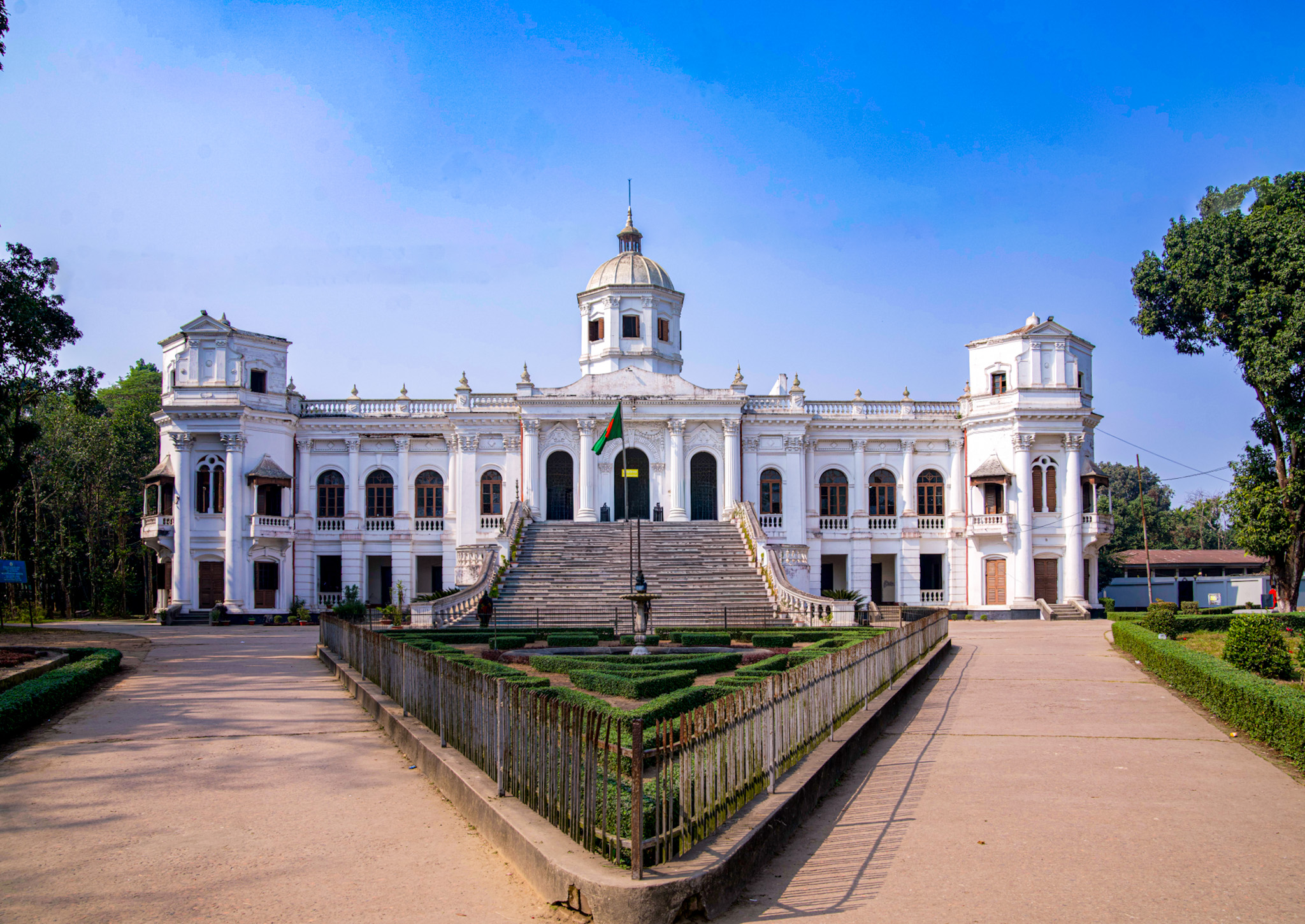
Just as you can see in this photograph — dazzling white, proud and symmetrical beneath the open sky — as though someone’s innermost dream had stepped outside and turned to stone.
The front of the palace stretches nearly 76 metres wide, rising two storeys and facing east — as if greeting the morning sun each day. Right at its centre stands a grand staircase paved with imported white marble, climbing directly up to the floor above. You can almost picture the Maharaja himself descending those steps on a festive morning, a crowd gathered below, the air alive with music and the fragrance of flowers.
And at the very top — crowning the palace — sits a ribbed dome, resting upon a tall octagonal neck, surrounded on all sides by rows of slender Corinthian columns. The silhouette is so singular that it seems to belong to another world entirely — a world where Bengal and Europe met and introduced themselves to each other in stone.
Architects call this style Indo-Saracenic — a magnificent weaving together of Mughal grandeur, European classical elegance, and the distinct character of Bengal.
Silence Falls
But kingdoms, like seasons, must change.
In 1950, the zamindari system was abolished across East Bengal. Land was seized. Power slipped away. The palace that had once rung with the laughter of celebrations fell silent. After 1947, the building was declared abandoned and handed over, along with 55 acres of land.
For years the palace stood in a dignified silence — too magnificent to be demolished, yet not remembered enough to be properly preserved.
A New Life Begins
Then, slowly, the world remembered.
In 1984, the palace was opened as a branch of the High Court. The marble staircase that had once echoed with the footsteps of a Maharaja now hummed with the footfalls of lawyers and judges. In 1995, the Department of Archaeology declared it a protected monument.
And in 2005 came perhaps the most fitting chapter of all. The government relocated the Rangpur Museum into the palace. The very room at the top of those marble stairs where the Maharaja once held court now displays terracotta artifacts from the 10th and 11th centuries. Sanskrit and Arabic manuscripts line the shelves — and among them, a copy of the Holy Quran said to have been written in the hand of none other than the Mughal Emperor Aurangzeb.
The palace that was built to preserve one family’s glory now holds within it the memory of an entire civilization.
Even today, five to six hundred people cross those marble steps every single day. They come from across Bangladesh, from all corners of the world. Some come to admire the architecture. Some come to learn history. And some cannot quite explain why they come at all — they only know that when they arrive, they feel a strange pull deep within. Because certain places hold inside their walls the memory of every soul that ever walked through them — and Tajhat Zamindar Bari still whispers that story, to anyone who will listen.